


The hydrogen economy needs to develop on a European scale, and for this to happen, a fundamental condition must be met: the existence of common standards for the quality of hydrogen transported, stored, and used. The absence of these common standards can affect cross-border transport, infrastructure interoperability, and the development of the European hydrogen market.
DG ENER (Directorate-General for Energy), the European Commission's general directorate for EU energy policy, coordinated the study ”Technical Assistance on Hydrogen Quality Standardisation.„ This was summarized by ENTSOG in document „Conclusions from the European Commission's consultation on hydrogen quality.
The following presents some of the aspects revealed in these documents.
Definition of Optimum Hydrogen Quality
Identifying optimal H₂ quality is very complex: beyond the minimum H₂ content, limits for specific contaminants (e.g., sulfur) or physical properties (e.g., Wobbe index) are also relevant.
The DG ENER study develops three indicative specifications, based on technical literature and stakeholder input, following consultation by the study authors: H₂ content of >98 mol%, >99.5 mol%, and >99.97 mol%, respectively, plus limits for key contaminants.
Stakeholder opinions vary: some storage and reused pipeline operators consider lower purity levels (i.e., >98 mol% H₂) to be appropriate, while other H₂ transport operators, industrial network operators, and many end users prefer higher levels, of approximately >99–99.5 mol% H₂.
End-User Requirements
End-user requirements primarily relate to substances with contamination potential and combustion properties for engines, turbines, and combustion plants.
WHO ARE THE END USERS IN THE CASE OF HYDROGEN? Industry (in which hydrogen plays the role of a raw material), steelmaking, and the energy sector are considered key markets for hydrogen in the future.
Hydrogen can also play a significant role in the transport sector, through the production of e-fuels (synthetic fuels) and through direct use in fuel cells (heavy transport).
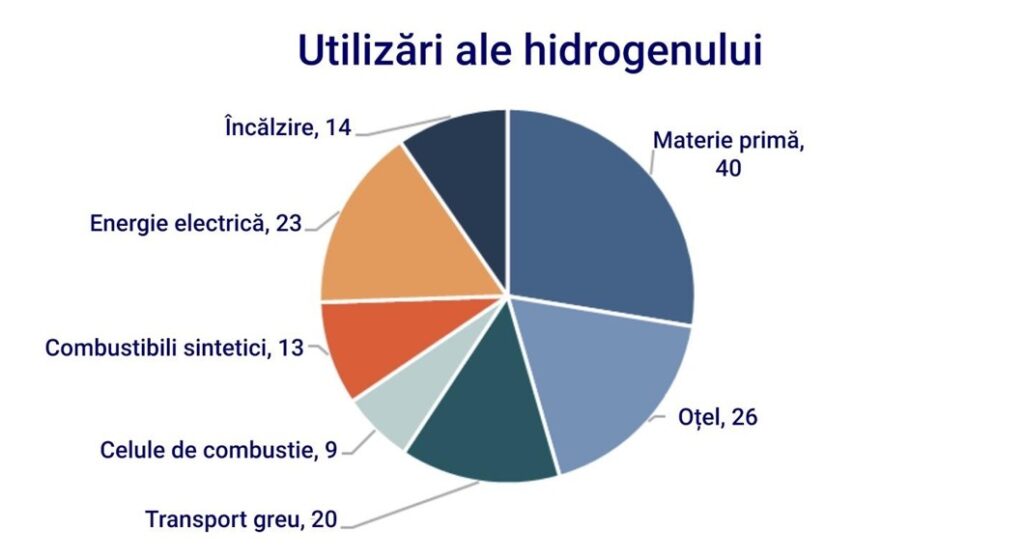
Hydrogen is considered to have a limited role in residential heating.
How is hydrogen purity viewed in these areas?
For some industrial applications, the level of purity is of secondary importance. The main requirement is that impurities do not disrupt industrial processes.
For end-users in the electricity and heat generation sectors, lower cost is a more important criterion than a high degree of purity.
In general, industrial users require consistent quality. For some of them, quality consistency is more important than the actual level of purity.
TRANSPORTATION AND STORAGE
In the transport and storage of hydrogen, the required purity level depends on: the type of infrastructure used, the possibility of adapting existing natural gas pipelines for hydrogen transport, the storage method (salt caverns vs. porous media), the risk of contamination with oxygen, nitrogen, hydrocarbons, or sulfur compounds, and the distance from storage facilities.
The study examines two options: 98.1% purity and 99.51% purity, respectively.
Reasons for a purity of 98%:
Storage operators, with the exception of those using salt caverns, argue that any purity level above 98.1% is not economically viable for them.
Stakeholders maintain that the volume required for storage needs exceeds the capacity of existing salt caverns in the EU.
Stakeholders who request this level of quality are generally:
- transport and system operators (TSOs) associated with porous media storage and storage operators not using salt caverns;
- more cautious regarding the technical and economic feasibility of hydrogen storage;
- Geographically locate further from areas with salt cavern storage (Italy, Austria, Czech Republic, France).
Reasons for a purity of 99.51%:
- There is a high level of confidence in the technical feasibility.
- Distribution system operators (DSOs) are requesting a quality safety margin because their grids will contaminate hydrogen (leaks, adsorbed odorants, low-flow networks).
- According to recent studies (which are yet to be confirmed), the level of 99.5% is considered economically optimal for the supply-demand balance.
Stakeholders who request this level of quality are generally:
- transport and system operators (TSOs) directly associated with salt cavern storage;
- located geographically closer to salt cavern storage areas (Netherlands, Belgium, Germany, Denmark).
PURIFICATION COSTS
Evaluations of purification efforts along the supply chain indicate an additional cost level of approximately €0.8–€1.2/kg in the key scenarios analyzed.
The main cost factors for purification processes:
- oxygen removal and pressure swing adsorption (PSA), with a significant impact of economies of scale and energy consumption;
- reused pipelines and storage in porous media;
- network and market development, as well as the share of different end-user categories.
The total purification costs of the system are determined by:
- network configuration (e.g., the proportion of reused pipes and porous storage)
- End-user modalities.
These differ between member states. Therefore, the future harmonization process cannot be determined solely technically, but will also require political agreement.
The full text can be consulted here: entsog.eu
